
Untapped talent: A national look at unfilled jobs and unmatched student potential


2025 State of the Future U.S. Workforce
Untapped talent:
A national look at unfilled jobs and unmatched student potential
Solutions for the critical gap between student aptitudes and the needs of the U.S. workforce
DOWNLOAD
-
 Download the Full Report
The power of career exposure
A critical disconnect exists within the U.S. workforce: students possess the inherent skills for thriving in sectors like healthcare, manufacturing, technology, and finance, yet limited career awareness may deter them from pursuing these paths after graduating.
Ignoring these talent shortages has serious consequences. Healthcare suffers from longer wait times and delayed treatments. Technological innovation stagnates, hindering critical advancements. Manufacturing productivity can decline, impacting our global competitiveness. And an unstable market—a byproduct of a shortage of skilled financial professionals—is certainly not desirable.
What we need is more student exposure to diverse career pathways. And quickly. With it, we can better tap into the potential that already exists within the future workforce.
This report is a predictor of future workforce challenges. We use our own anonymized, proprietary data collected across thousands of schools in the U.S. to explore areas of opportunity—and concern—in several at-risk industries.
About this report
This report reflects the data analysis of 450,000 middle and high school students nationwide who took the YouScience® Aptitude & Career Discovery assessment in 2024. YouScience uses a computerized variation of the Ball Aptitude Battery (BAB), the Interest Profiler Short Form (IPSF) developed by the National Center for O*NET Development, and AI-powered algorithms to identify scientifically-accurate best-fit career matches for each student.
Aptitude
is defined as an individual’s natural ability to learn or perform in given areas. Aptitudes are innate and can guide individuals toward careers and pursuits where they are likely to thrive and succeed.
Interests
are self-reported activities someone wants to know or learn about. Unlike aptitudes, interests are shaped by experiences, environment, and exposure, and can evolve over time.
Executive summary
Ideally, students pursue careers aligned with both their aptitudes and interests. This “sweet spot”—where student strengths and passions converge within specific career clusters—creates prime candidates for industry engagement.
The data shows that a small subset of students (4-8% across industries) already exhibit this ideal alignment in specific career clusters. Capitalizing on these engagement opportunities through targeted programs, mentorship opportunities, or internships can solidify students’ career choices and ensure they have the necessary skills to succeed.
However, the data reveals a more nuanced reality: a frequent mismatch between student aptitudes and interests. Many students possess aptitudes for careers they haven’t considered (12-28% across industries). Conversely, career interests are often shaped by exposure—influencers, firefighters, pro-athletes—while overlooking those congruent with their underlying strengths.
Creating early career exposure opportunities, such as career fairs, CTE program involvement, and industry-recognized certifications, are crucial. These experiences can spark student interest in careers they may not have considered, bridging the gap between aptitude and interest, and ultimately creating the workforce we all hope for.
There are gaps in key industries that are needed to bolster the U.S. economy
%
gap of students with an aptitude but no interest in Architecture & Construction
%
gap of students with an aptitude but no interest in Finance
%
gap of students with an aptitude but no interest in Health Science
%
gap of students with an aptitude but no interest in Information Technology
%
gap of students with an aptitude but no interest in Manufacturing
%
gap of students with an aptitude but no interest in Transportation, Distribution & Logistics
In-demand careers & student aptitudes
Based on our analysis of 450,000 data points, students have the aptitudes to be successful in these in-demand careers.
But aptitudes are only one piece of the puzzle—student interests must also be considered, and they don’t always align with their aptitudes.
Herein lies the opportunity. We’re calling on educators and industry partners to leverage exposure as a way to be more targeted when guiding students’ postsecondary pursuits.
Focusing on early career exposure can make (or break) our future workforce.

Architecture & Construction

The construction industry’s growth in North America continues to skyrocket, with a 32% increase projected by 2030.1 This surge demands a skilled workforce.
Employment is projected to grow 8% for architects2 and 9% for construction managers through 2033.3 An average of 195,000 openings are projected each year in these occupations due to increased demand for these skills and the need to replace workers who leave the occupations permanently.4
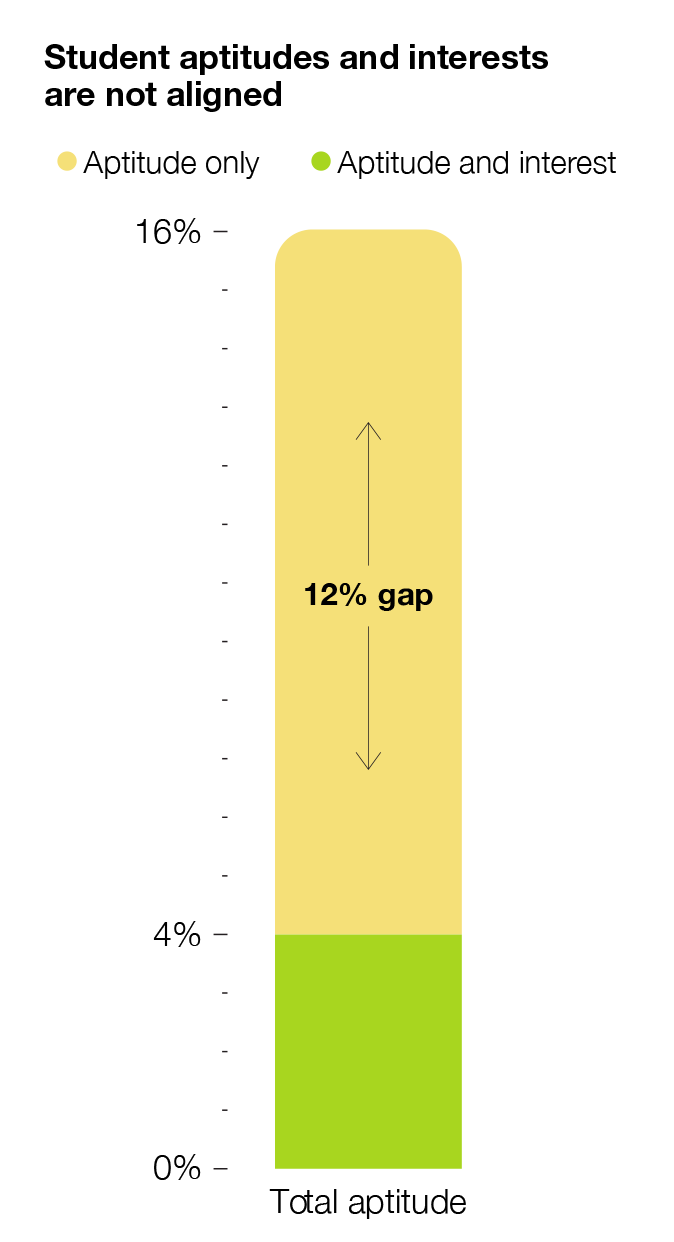
Despite 16% of students showing potential in Architecture & Construction, only 4% expressed both aptitude and interest in these fields. This indicates a significant gap of 12%, these students could benefit from targeted career exposure initiatives by proactive recruiters.
Addressing this gap is crucial. Failing to do so will likely result in persistent talent shortages within the Architecture & Construction sector for years to come.
Finance


As the aging U.S. population’s retirement years near, more demand for financial planning and wealth management services will abound—yet only 1% of students demonstrate both aptitude and interest in finance-related careers.
What’s more, rapid advancements in fintech and artificial intelligence are creating never-before-seen functions in the field, expanding the industry beyond traditional roles like financial advisors (which itself is booming, with 17% annual growth predicted through 2033).5 Innovations like blockchain, AI, and big data command professionals with specialized skills in areas like analytics, cybersecurity, and financial modeling.
Despite 19% of students showing aptitude for careers in Finance, the majority of them (18%) don’t show interest in these careers. More targeted career exposure to the diverse career paths in this field could increase the number of students pursing these careers and meet the growing economic needs of this industry.
Health Science

Another industry significantly impacted by the rapidly aging population and an approaching workforce shortage is healthcare—and that’s before we consider Americans are living longer. This presents a significant opportunity to address talent shortfalls by engaging and inspiring the 36% high school graduates who have the aptitude to pursue fulfilling careers in Health Science.
The healthcare and social assistance sector is projected to add about 1.9 million jobs annually through 2033.6 Nurse practitioners are one of the top three fastest-growing occupations of any sector at a clip of 46%; other health professions like medical and health services managers and physician assistants round out the top 10 fastest growing careers this decade.7
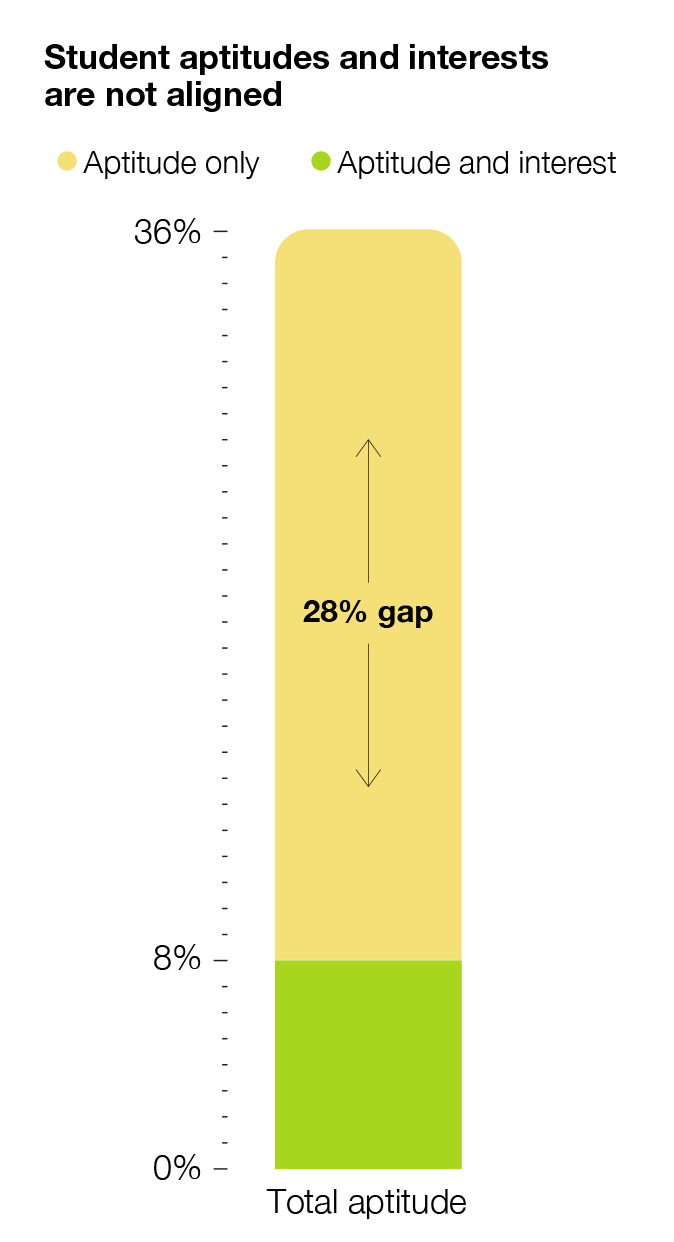
While 36% of students demonstrated aptitudes for these professions, only 8% expressed both aptitude and interest. This suggests a substantial 28% gap in students who have the proven aptitude but no reported interest.
Information & Technology


While 27% of students demonstrated aptitudes for careers in Information & Technology, only 3% exhibited both aptitude and interest—leaving a 24% gap.
This gap in supply and demand is particularly critical given the strong growth projected for the IT sector. More than 300,000 new software development jobs are expected to be added annually, with a median salary of $132,270.8 A student’s lack of exposure to the IT field might not only cost them a meaningful career, but a six-figure salary, too.
Employment in computer and information technology occupations is projected to grow much faster than the average for all occupations from 2023 to 2033.9
Advanced Manufacturing

The manufacturing sector plays a vital role in the U.S. economy, contributing significantly to the production of goods that are essential to our daily lives. Professional careers in manufacturing see a median annual wage of $102,629.10 The sector is projected to experience steady growth, driven by factors such as advancements in technology, reshoring of manufacturing operations, and an increasing emphasis on domestic production.
While overall employment in production occupations is projected to decline slightly over the next decade, there will still be a significant demand for skilled workers. An estimated 970,100 job openings are projected each year.11
With only 3% of students with aptitude showing interest, 18% could benefit from greater exposure to career opportunities to help fill projected job openings.

Transportation, Distribution & Logistics


As a robust economy and the fourth largest country in the world by land size, the U.S. relies heavily on efficient transportation and logistics. Moving goods across the nation is crucial for our economic success. And that’s why the Transportation, Distribution & Logistics field is poised for continued expansion in the next decade and beyond.
A staggering 1.9 million jobs will be added annually to the field,12 so it’s pivotal that we close the 18% gap for students making sure they are engaged—and engaged soon.
Transportation, Storage, and Distribution Manager jobs are expected to grow 9% annually13; much higher than the 4% average across all sectors.
What you can do
Our report data makes clear: students possess the aptitudes to thrive in high-demand professions. However, aptitudes alone do not guarantee a fulfilling and successful postsecondary path. Student interests must be equally considered, and these often diverge from their inherent abilities. This disconnect can negatively impact a student’s career trajectory and hinder the development of a skilled workforce ready to alleviate critical workforce shortages.
This presents a significant opportunity. We urge educators, businesses, and policymakers to prioritize early career exposure opportunities as a strategic approach to guide students’ choices more effectively.

- Mandate or incentivize the use of performance-based aptitude assessments in schools.
- Allocate funding for programs and initiatives that connect students with diverse career options.
- Develop and support statewide initiatives that promote and expand Career-Connected Learning opportunities.
- Partner with schools to provide industry speakers, site visits, and mentorship programs.
- Collaborate with schools to develop and deliver industry-recognized certifications.
- Offer a variety of work-based learning opportunities, including internships, apprenticeships, and mentorship programs.
- Administer and interpret aptitude and interest assessments to guide student learning and career exploration.
- Develop and implement engaging career exploration activities, including guest speakers, Career-Connected Learning experiences, field trips, and career fairs.
- Guide students through the process of obtaining industry-recognized certifications.
About YouScience
YouScience® is the award-winning college and career readiness platform powered by scientifically-backed aptitude data. YouScience® Brightpath, connects education with career applications designed to help students unlock their potential for future pathways. YouScience leverages proven research, artificial intelligence, and industry input to help individuals identify their aptitudes, validate their skills and knowledge, and get matched with real-world educational and career pathways in high-demand occupations. YouScience is the preferred choice of individuals, parents, educators, and counselors to guide and support educational and career pathways, currently serving more than 11,600+ educational institutions and millions of users nationwide.
- https://www.oxfordeconomics.com/resource/future-of-construction/
- https://www.bls.gov/ooh/architecture-and-engineering/architects.htm
- https://www.bls.gov/ooh/management/construction-managers.htm
- https://www.bls.gov/ooh/architecture-and-engineering/
- https://www.bls.gov/ooh/business-and-financial/personal-financial-advisors.htm
- https://www.bls.gov/ooh/healthcare/home.htm
- https://www.bls.gov/ooh/fastest-growing.htm
- https://www.bls.gov/ooh/computer-and-information-technology/
- https://www.bls.gov/ooh/most-new-jobs.htm
- https://nam.org/manufacturing-in-the-united-states/facts-about-manufacturing-expanded/
- https://www.bls.gov/ooh/production/
- https://www.bls.gov/ooh/transportation-and-material-moving/home.htm
- https://www.bls.gov/ooh/management/transportation-storage-and-distribution-managers.htm